

Reading the water → Identifying the food →
Understanding the hatch → Selecting the fly.
THE WATERS — HATCHES, FOOD & FLY SELECTION
Understanding a trout river means understanding more than where the fish live. Anglers also need to recognize what trout are feeding on, how aquatic insects develop, when important hatches occur, and which fly patterns best imitate those natural foods. Riverbound Waters™ connects these pieces so the angler can move logically from
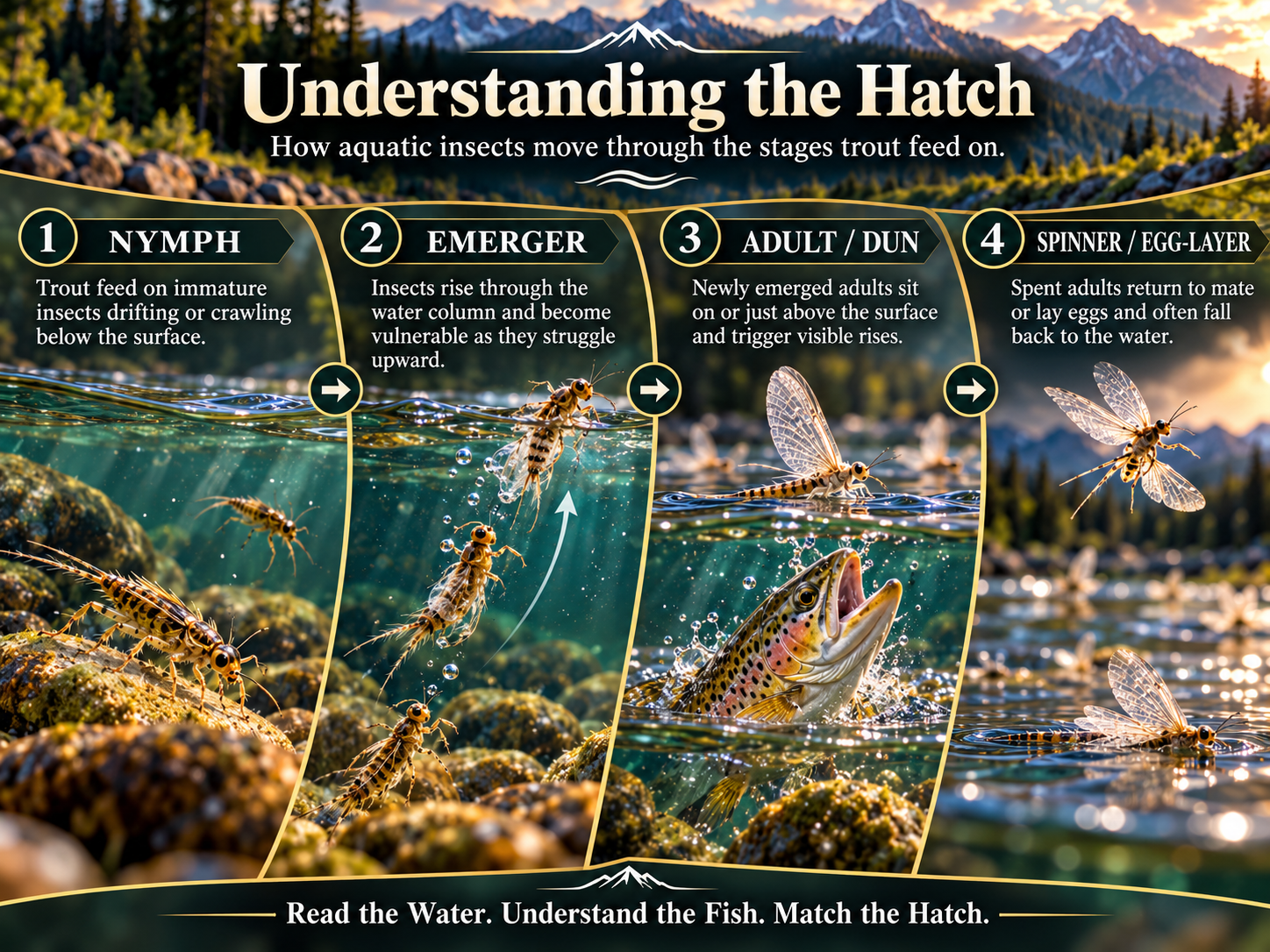
UNDERSTANDING THE HATCH
Aquatic insects change form as they develop, and trout may feed on different stages of that life cycle. Recognizing the stage fish are targeting is often just as important as identifying the insect itself.
NYMPH — The immature underwater stage. Nymphs live along the stream bottom, among rocks and vegetation, and are an important year-round food source for trout.
EMERGER — The transitional stage as an insect rises toward the surface. Emergers can be especially vulnerable and often trigger concentrated trout feeding.
ADULT / DUN — The newly emerged winged insect resting on or near the surface. This is the stage that often produces the classic visible dry-fly rise.
SPINNER / EGG-LAYER — Mature adults return to the water to mate or deposit eggs. Spent insects may collect on the surface and create another important feeding opportunity.
Know the Stage. Match the Behavior. Present the Fly.
COMMON TROUT FOOD SOURCES
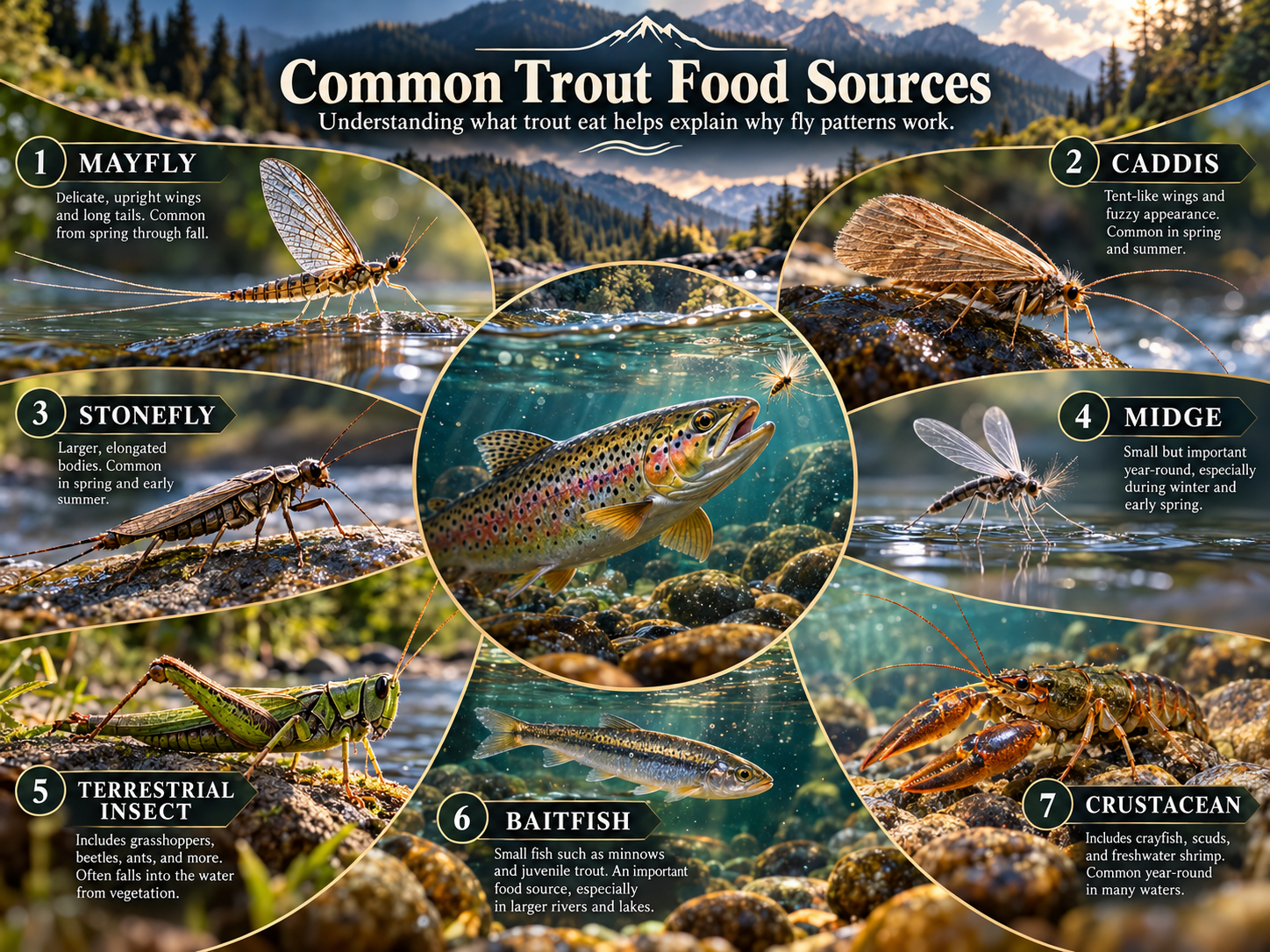
Trout are opportunistic feeders, but much of their diet can be organized into several recognizable food groups. Understanding these natural foods helps explain why particular fly patterns are effective.
MAYFLY — Delicate aquatic insects with upright wings and long tails. Their nymph, emerger, dun, and spinner stages provide numerous fly-fishing opportunities.
CADDIS — Tent-winged insects common in streams and rivers. Their larval, pupal, and adult stages can all become important trout food.
STONEFLY — Larger aquatic insects with elongated bodies. Their nymphs crawl along the bottom before emerging near shore, creating important seasonal feeding events.
MIDGE — Very small aquatic insects that can be present throughout the year and become especially important when larger insects are scarce.
TERRESTRIAL INSECTS — Grasshoppers, ants, beetles, and other land insects that fall or are blown into the water, particularly during warmer months.
BAITFISH — Minnows, juvenile fish, and other small fish prey. Larger trout may feed heavily on them where conditions allow.
CRUSTACEANS — Crayfish, scuds, freshwater shrimp, and similar organisms that provide a protein-rich food source in many rivers and lakes.
Understand the Food. Understand the Fly.
FROM NATURAL FOOD TO FLY PATTERN
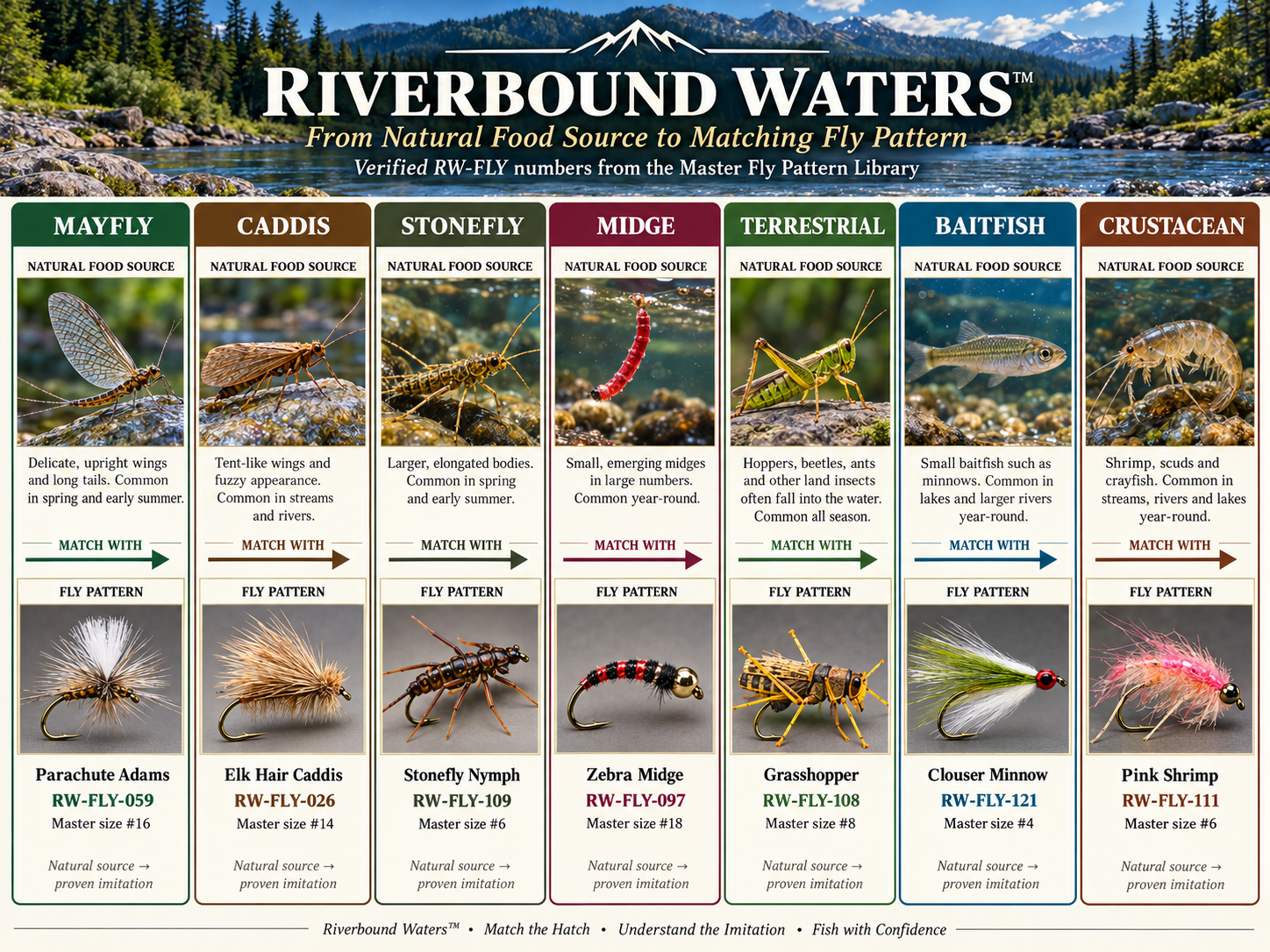
This page closes the loop. Once an angler identifies what trout are eating, Riverbound Waters™ connects the natural food source directly to a recognizable fly pattern from the fly-pattern collection.
MAYFLY → PARACHUTE ADAMS — A versatile dry-fly imitation representing adult mayflies and other similar surface insects.
CADDIS → ELK HAIR CADDIS — A proven floating pattern that imitates the profile and behavior of an adult caddis.
STONEFLY → STONEFLY NYMPH — A subsurface imitation designed to represent the larger stonefly nymphs found along the river bottom.
MIDGE → ZEBRA MIDGE — A simple, effective subsurface pattern representing the small midge forms trout regularly encounter.
TERRESTRIAL → GRASSHOPPER — A surface pattern representing land insects that fall into the river from banks and surrounding vegetation.
BAITFISH → CLOUSER MINNOW — A streamer-style pattern designed to imitate small fish and other moving prey.
CRUSTACEAN → PINK SHRIMP — An imitation of shrimp, scuds, and similar aquatic crustaceans found in productive trout waters.
See the Food. Choose the Imitation. Fish With Purpose.
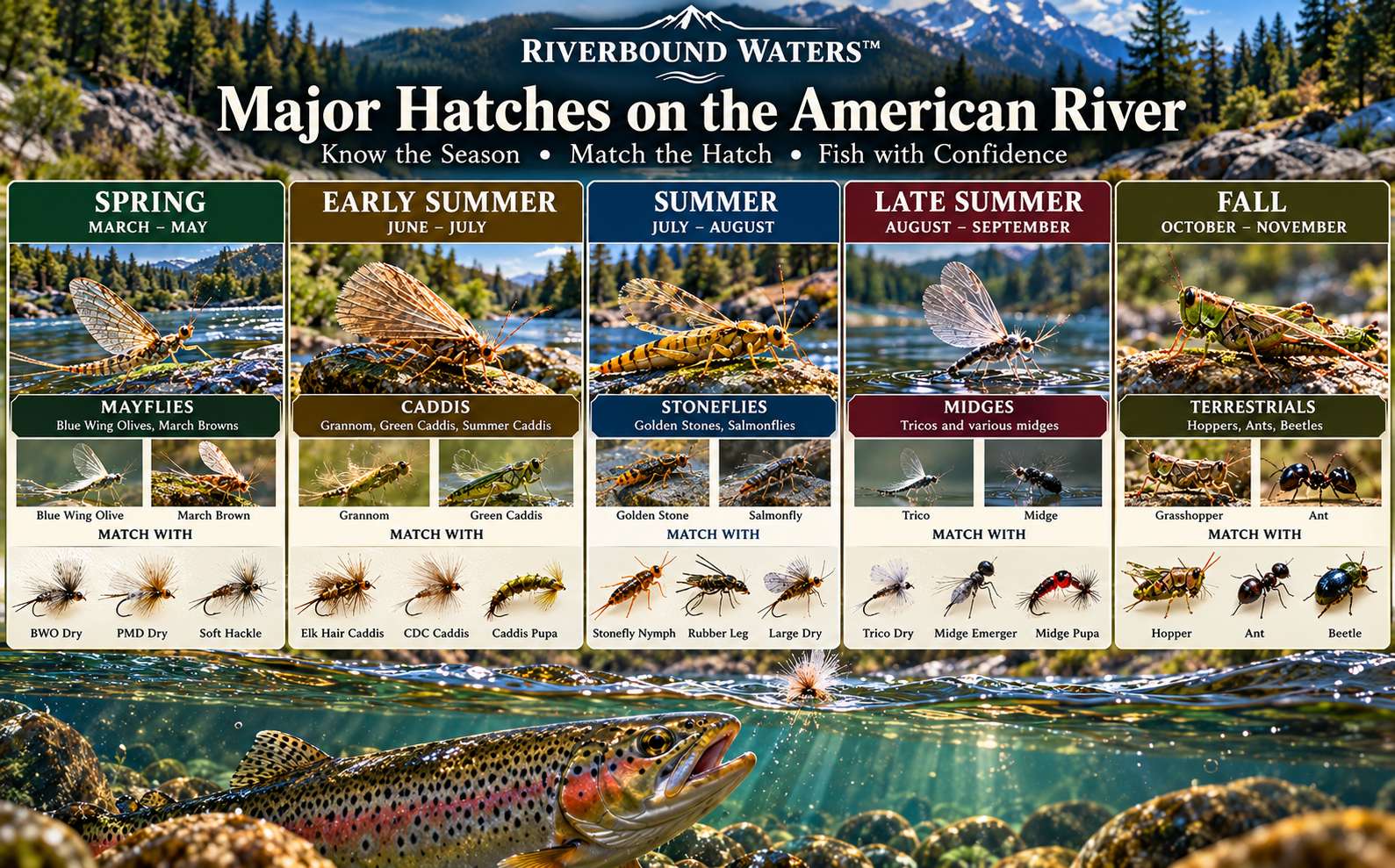
MAJOR HATCHES ON THE AMERICAN RIVER
Hatches change throughout the fishing season. This page gives anglers a quick seasonal picture of which food sources are likely to become important and which families of fly patterns should be considered.
SPRING — MAYFLIES — Blue Wing Olives and March Browns become important as conditions improve. Match them with appropriate nymphs, emergers, and dry flies.
EARLY SUMMER — CADDIS — Grannom, Green Caddis, and other caddis activity can produce strong subsurface and evening surface feeding.
SUMMER — STONEFLIES — Golden Stones and Salmonflies provide larger food sources and can create opportunities with both nymphs and large dry flies.
LATE SUMMER — MIDGES — Small midges and Tricos become increasingly important, often requiring more precise presentation and smaller patterns.
FALL — TERRESTRIALS — Grasshoppers, ants, beetles, and other land insects can become productive choices along banks and vegetation.
Know the Season. Match the Hatch. Fish With Confidence.
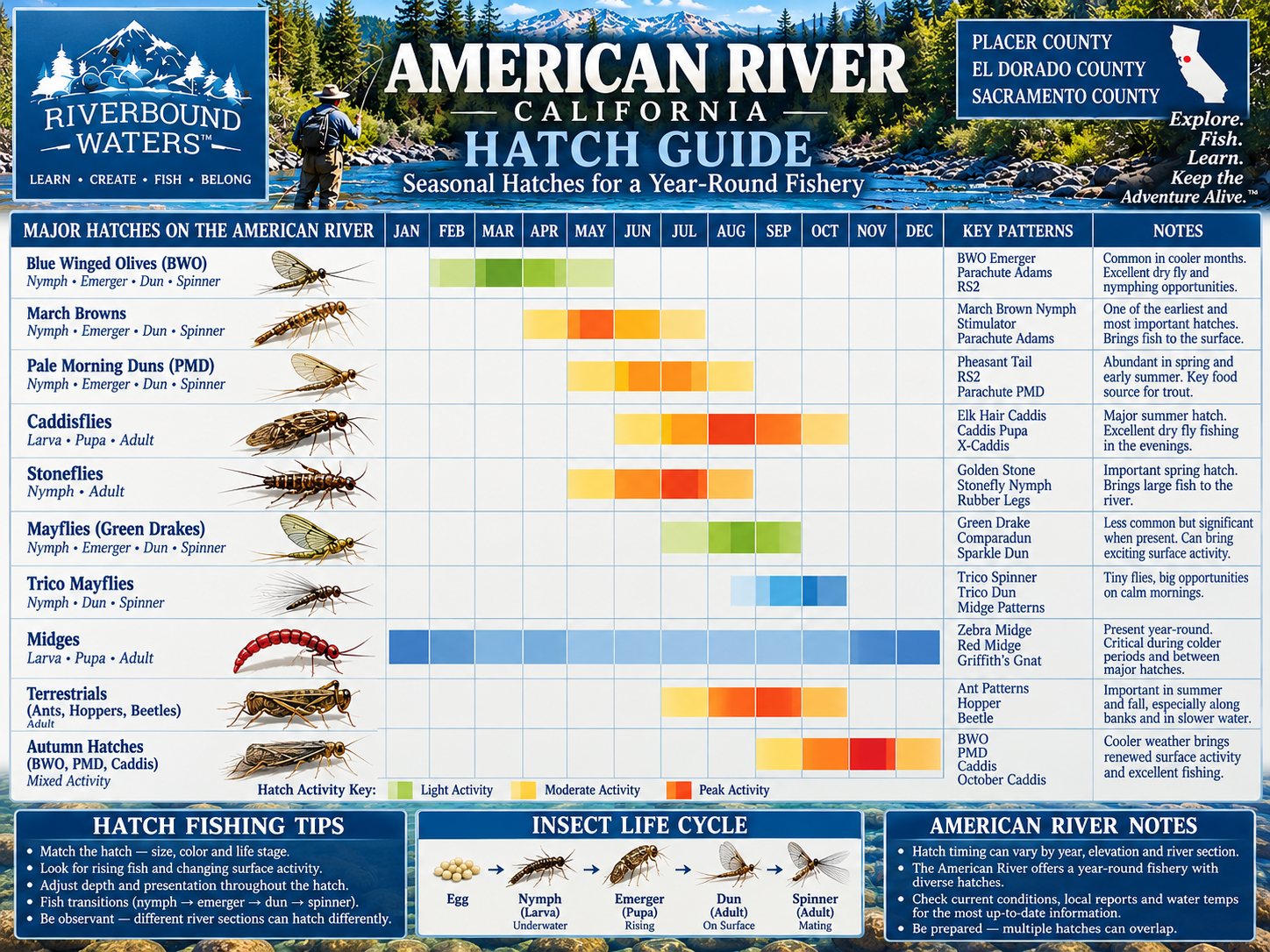
AMERICAN RIVER HATCH GUIDE
The Hatch Guide turns seasonal insect activity into a practical planning tool. Rather than simply naming insects, it shows when they are active, when activity peaks, and which fly patterns can imitate them.
MONTH-BY-MONTH ACTIVITY — Shows when each hatch normally begins, strengthens, peaks, and declines.
LIGHT ACTIVITY — Indicates periods when an insect may be present but is not necessarily the dominant food source.
MODERATE ACTIVITY — Shows periods when anglers should begin considering the insect as an important part of their fly selection.
PEAK ACTIVITY — Identifies the strongest seasonal window, when trout may become particularly focused on that food source.
KEY PATTERNS — Connects each hatch to proven fly types such as Parachute Adams, Pheasant Tail, Elk Hair Caddis, Zebra Midge, and terrestrial patterns.
HATCH FISHING TIPS — Reminds anglers to consider size, color, life stage, rising fish, changing surface activity, depth, and presentation.
LIFE-CYCLE REFERENCE — Reinforces the progression from egg to nymph or larva, emerger or pupa, adult, and spinner.
Timing Matters. Life Stage Matters. Presentation Matters.