
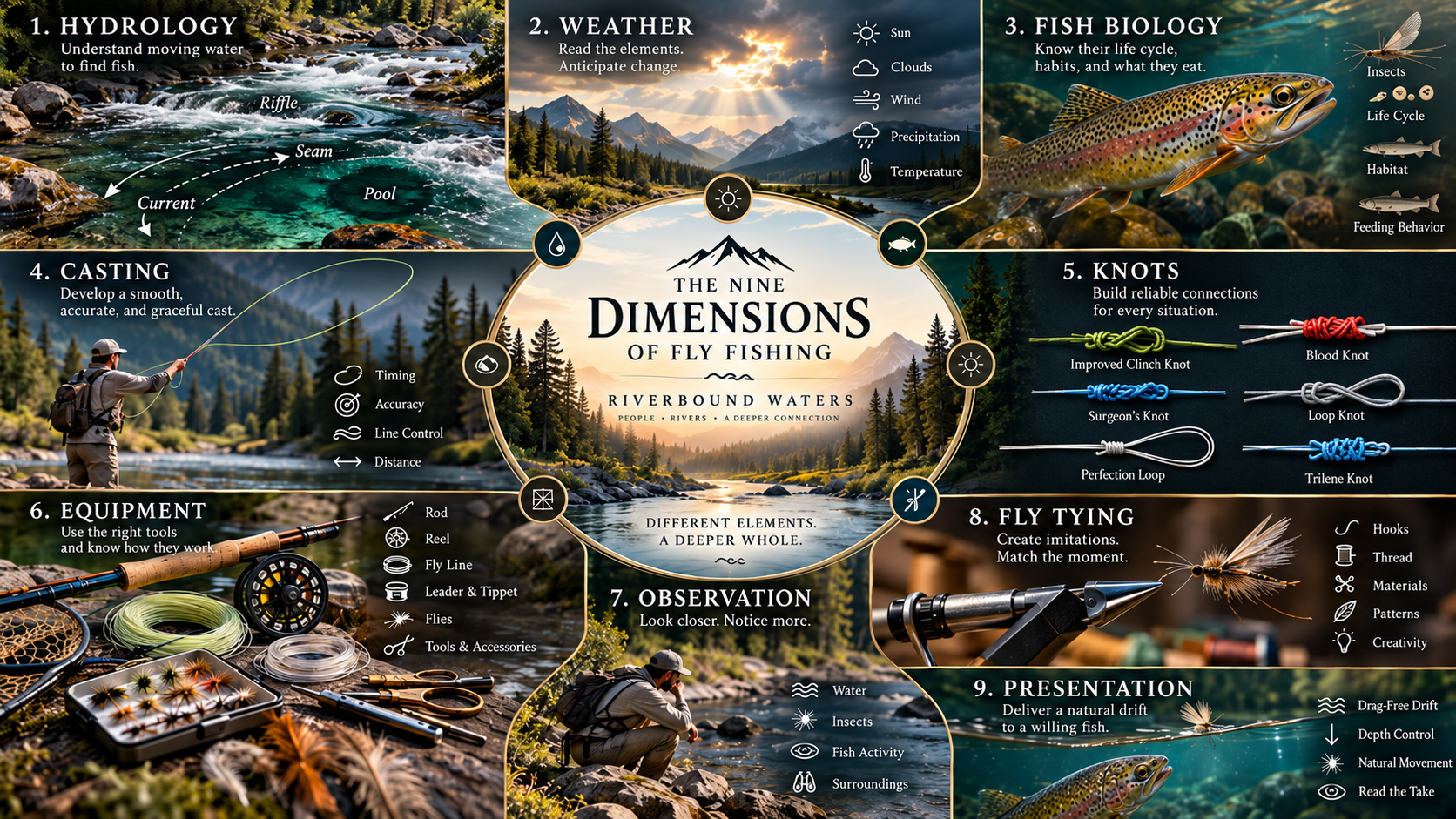
The Nine Dimensions of Fly Fishing
Fly fishing becomes much easier to understand when you recognize that success is rarely controlled by a single factor. It comes from learning how several dimensions work together.
Hydrology
Learn to read current, depth, seams, riffles, pools, eddies, temperature, and changing water levels. Water determines where trout can comfortably live, feed, and conserve energy.
Weather
Sun, clouds, wind, temperature, barometric changes, and approaching storms can influence insects, water conditions, fish behavior, and the way you approach the water.
Fish Biology
Understanding the species you are pursuing—how it feeds, where it holds, what temperatures it prefers, and how its behavior changes through the seasons—helps turn observation into better decisions.
Casting
Casting is not simply about distance. It is about delivering the fly accurately, controlling line and leader, managing current, and presenting the fly without unnecessary disturbance.
Knots
Every connection between angler and fish depends on a knot. Knowing a small number of reliable knots—and understanding where each belongs—creates confidence from backing to fly.
Equipment
Rod, reel, line, leader, tippet, indicators, weights, flies, and accessories should work together as a system. The best equipment is not necessarily the most expensive; it is the equipment appropriate for the water and technique.
Observation
Perhaps the most important skill of all. Watch the water. Turn over a rock. Notice the birds. Look for insects, rises, shadows, seams, and changes in current. The river is constantly giving you information.
Fly Tying
Understanding how a fly is constructed helps you understand what it represents and how it should behave in the water. Fly tying turns imitation into something you can see, understand, and create for yourself.
Presentation
The right fly presented incorrectly may be ignored. The correct depth, drift, retrieve, angle, speed, and position often matter as much as the pattern itself.
When the Dimensions Connect
None of these skills exists alone.
Hydrology tells you where a trout might hold.
Fish biology helps explain why it is there.
Weather and insects help determine what it may be eating.
Fly tying helps you understand what you are imitating.
Equipment and knots connect everything together.
Casting puts the fly where it needs to go.
Presentation makes it behave naturally.
And observation tells you whether your assumptions were correct.
That is the heart of the Riverbound Waters™ approach:
Learn the pieces. Understand the connections. Then let the water tell you what to do next.