Exploring Riverbound Waters™
More Than Fly Fishing. A Way to Understand the Water.
There is a moment every fly angler knows.
You arrive at the river. The water looks good. Trout are there—you know they are there—you can see they are there. Insects move above the surface, perhaps a few fish rise, and your fly box contains dozens of possibilities.
Then come the questions.
Where should I fish?
What are the trout feeding on?
Which fly should I choose?
Should I fish the surface or below it?
How should I rig it?
Where in the water are the fish likely holding?
What changed since the last time I was here?
That moment is where Riverbound Waters™ begins.
Fly fishing is not one skill. It is many skills working together.
The water matters. The weather matters. The season matters. The insects matter. The fish matter. Your fly matters. Your leader, tippet, presentation, depth, drift, and position all matter.
Taken separately, each subject is understandable.
Put them together on a river, and fly fishing suddenly becomes multidimensional.
The purpose of Riverbound Waters™ is to make those dimensions understandable.
It Started with a Simple Question
Over many years of fishing, I developed a habit that became something of a family joke.
Before Carole and I headed to the water, I researched.
I wanted to know the weather, water conditions, time of day, fish species, seasonal behavior, likely insects, appropriate flies, rigging, and techniques before we ever launched the boat or made the first cast.
I enjoyed solving the puzzle.
Carole enjoyed catching the fish.
And somehow, despite all my research, she developed an uncanny habit of catching the first fish—and often the biggest fish.
Those experiences reinforced something I had learned during a lifetime working in engineering and education: when a complicated problem is broken into understandable pieces, it becomes much easier to solve.
Fly fishing works the same way.
The challenge was that much of the information an angler needed was scattered among books, websites, hatch charts, fishing reports, regulations, maps, fly-tying manuals, and years of personal experience.
I began asking myself:
What if the important pieces could be brought together?
That question eventually became Riverbound Waters™.
Understanding the Whole Fishing Experience
A successful day on the water rarely comes down to a single fly.
Imagine arriving at a river and discovering trout rising steadily along a shaded seam.
Knowing the name of a dry fly is useful.
But an angler may also need to understand what insect is hatching, what stage of its life cycle the trout are feeding upon, what size is appropriate, how the current will affect the drift, where the fish are positioned, what leader and tippet to use, and what presentation will allow the fly to behave naturally.
Change one factor and the answer may change.
That is why Riverbound Waters™ approaches fly fishing as a connected system.
The goal is not simply to tell an angler what to use.
The goal is to help the angler understand why it may work.
That difference is important.
Knowledge creates independence.
Once you understand the relationships between water, insects, fish, flies, rigging, and presentation, you are no longer limited to following someone else's recommendation.
You can begin making your own decisions.
The Waters Collection
Know the Water Before You Make the First Cast
Every river has a personality.
So does every creek, lake, tailwater, and mountain stream.
Some waters change dramatically with the seasons. Others respond to releases from dams, snowmelt, weather, temperature, or fishing pressure. A productive riffle in spring may become nearly empty in late summer. A deep pool that appears lifeless during the afternoon may become active as evening insects begin to emerge.
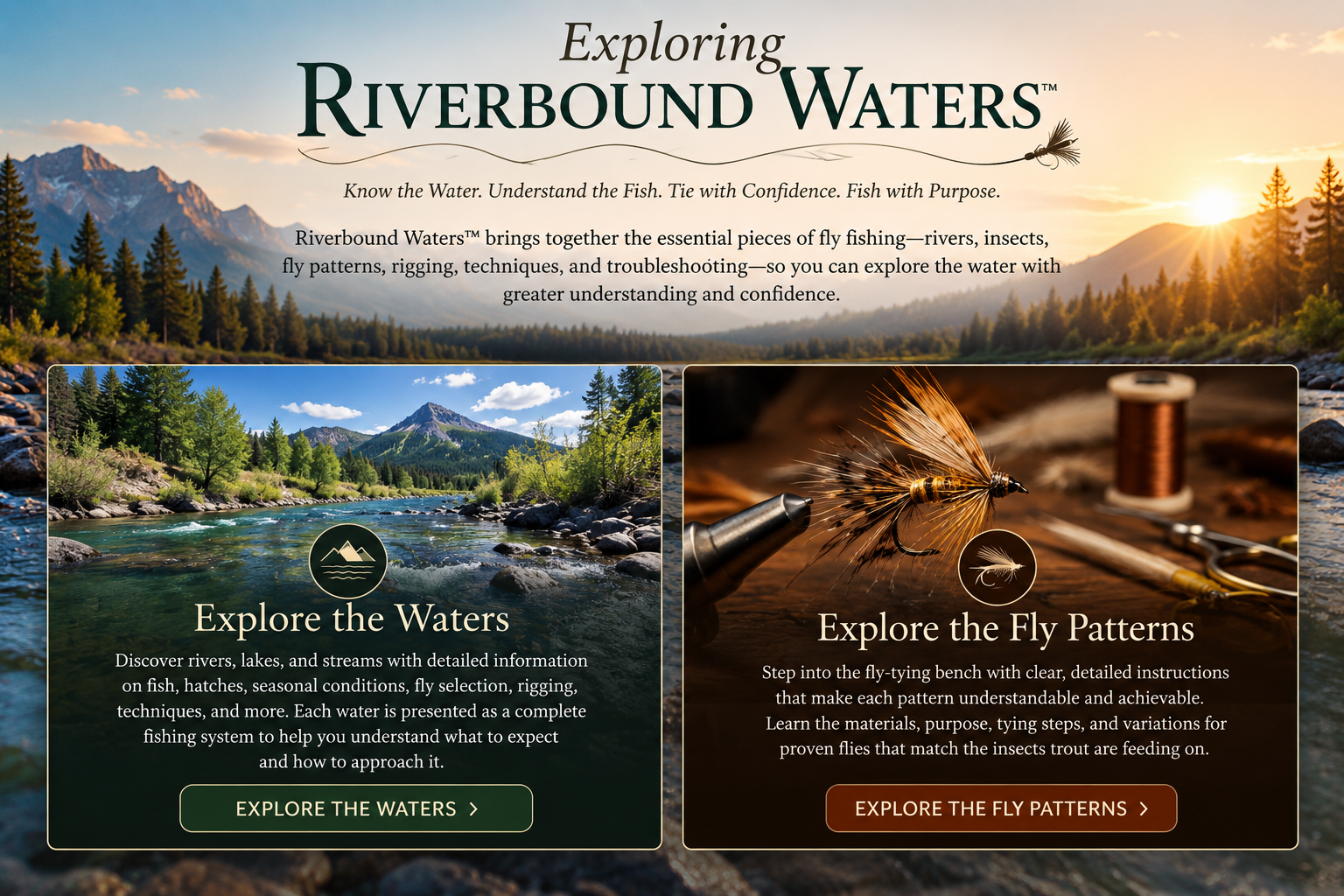
The Riverbound Waters™ Fly Fishing Waters Collections were created to help anglers understand those differences.
Each featured water is approached as a fishing system rather than simply a location on a map.
Depending upon the water, readers can explore information such as:
The Water — the character of the river, creek, or lake and what makes it distinctive.
Fish Identification — the species an angler may encounter and the characteristics that help identify them.
The Hatch — insects and other food sources that influence trout behavior throughout the season.
Fly Selection — patterns that may imitate those food sources.
Rigging — practical approaches for presenting dry flies, nymphs, emergers, streamers, and other patterns.
Techniques — strategies appropriate to the water and conditions.
Troubleshooting — what to consider when the approach that should be working simply isn't.
What Can Change — weather, flows, temperature, season, regulations, access, and other variables that can alter the fishing experience.
Access and Regulations — information intended to help anglers prepare responsibly before heading to the water.
The purpose is not to promise fish.
No fishing book can do that.
The purpose is to help an angler arrive at the water better prepared to understand what he or she sees.
The Fly Pattern Collection
From the River to the Tying Vise
The second major part of Riverbound Waters™ begins where many fishing guides stop.
Once you understand what the fish may be eating, another question naturally follows:
Can I tie the fly myself?
The answer should be yes.
Fly tying is sometimes presented as though it requires memorizing hundreds of individual procedures.
I believe there is a simpler way to understand it.
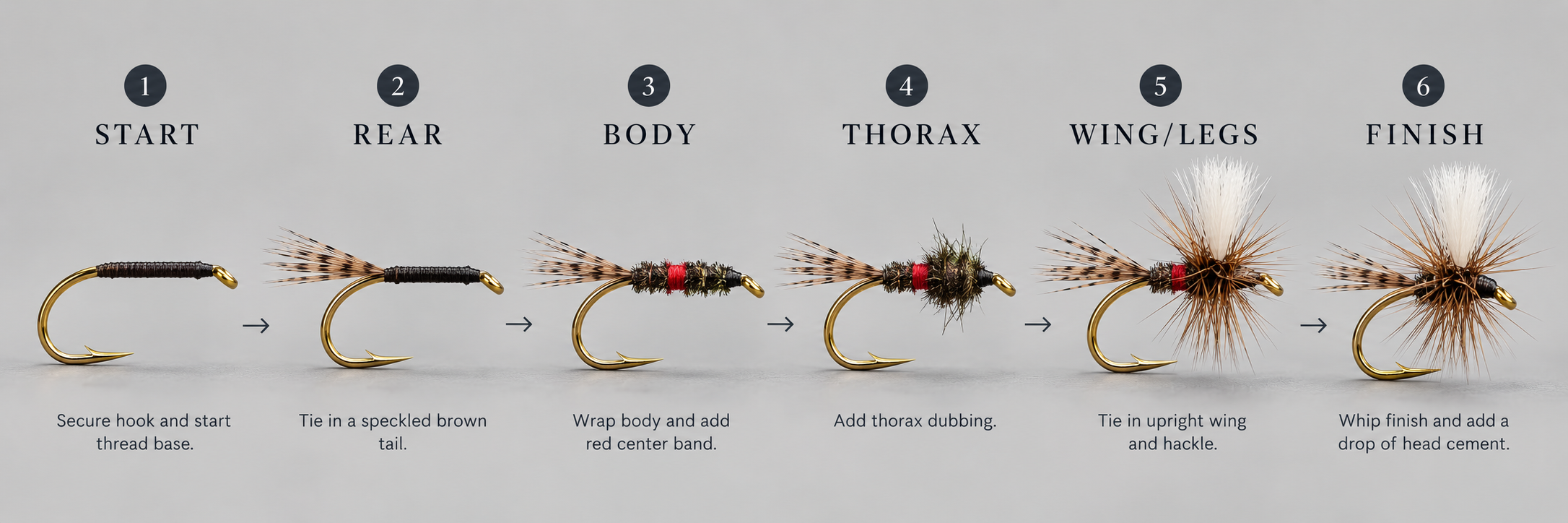
Most flies can be broken into a logical progression:
START → REAR → BODY → THORAX → WING/LEGS → FINISH
Not every fly uses every component, and some patterns add specialized techniques, but the basic idea remains the same.
Build the fly from one understandable element to the next.
That philosophy became the foundation of the Riverbound Waters™ Fly Pattern Collections.
Rather than overwhelming the beginning tier with dense blocks of terminology, the patterns are designed to provide visual structure and clear progression while still containing enough information to remain useful to experienced anglers.
The goal is something I describe simply as:
Expert Depth Without Expert Intimidation
A beginning fly tier should be able to open the collection, study a pattern, identify its components, and think:
I can tie that.
An experienced tier should still find enough information to understand materials, proportions, construction, purpose, and practical variations.
The two goals do not have to conflict.
Connecting the Fly to the Fish
One of the most important ideas behind Riverbound Waters™ is that a fly should not exist only as an object in a fly box.
It represents something.
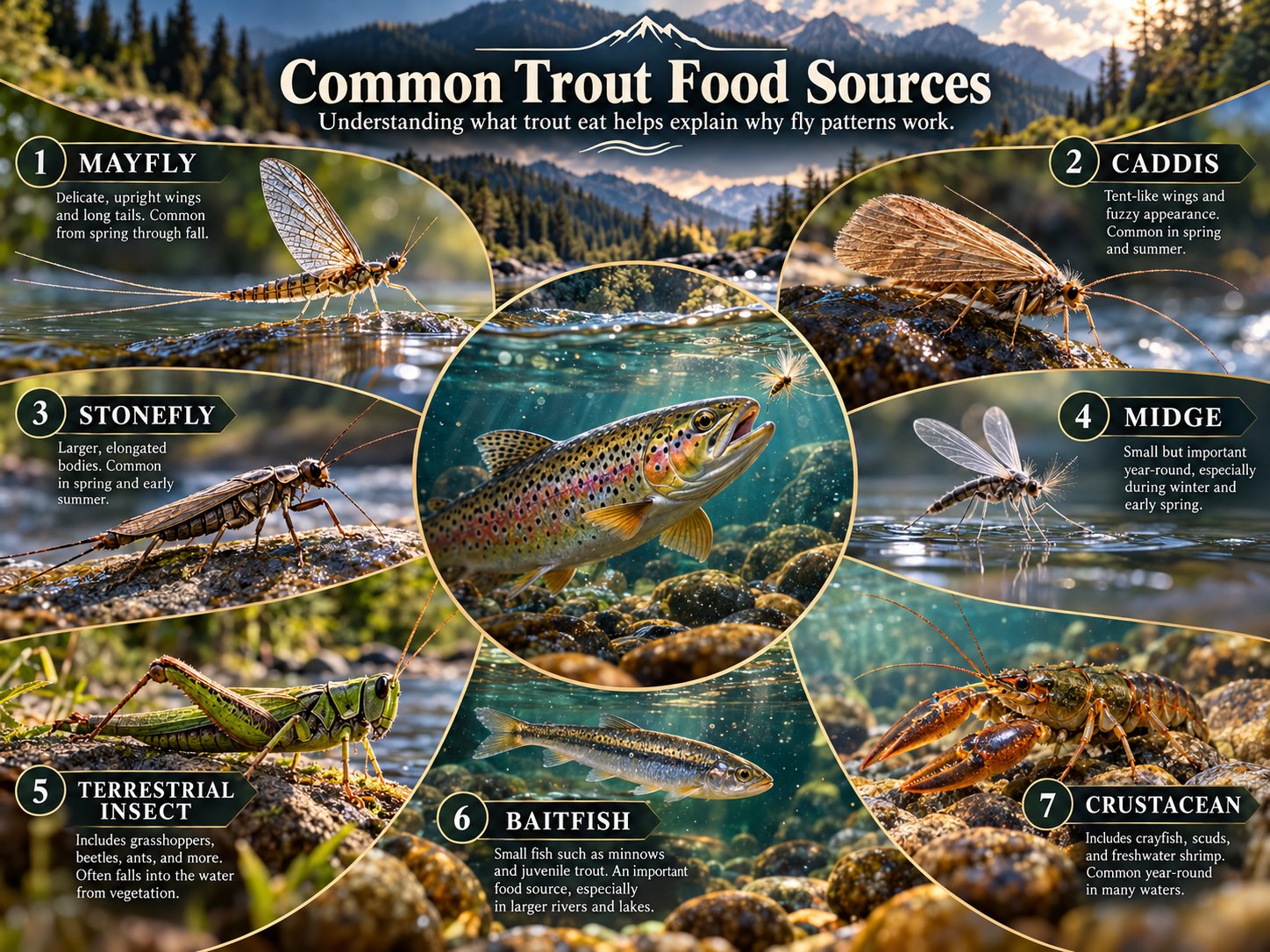
Perhaps a mayfly.
A caddis.
A stonefly.
A midge.
A terrestrial insect.
A baitfish.
A crustacean.
Or simply a combination of movement, silhouette, color, and behavior that triggers a fish to strike.
Understanding what the fly represents changes the way an angler fishes it.
A dry fly drifting naturally through a feeding lane is very different from a streamer swung across current.
A nymph moving near the bottom requires a different approach from an emerger rising through the water column.
Once anglers begin connecting the pattern to the food source—and the food source to fish behavior—fly selection becomes less mysterious.
That is one of the central purposes of Riverbound Waters™.
Not simply:
Use this fly.
But:
Understand why you might use this fly.
Fly Fishing Is Multidimensional
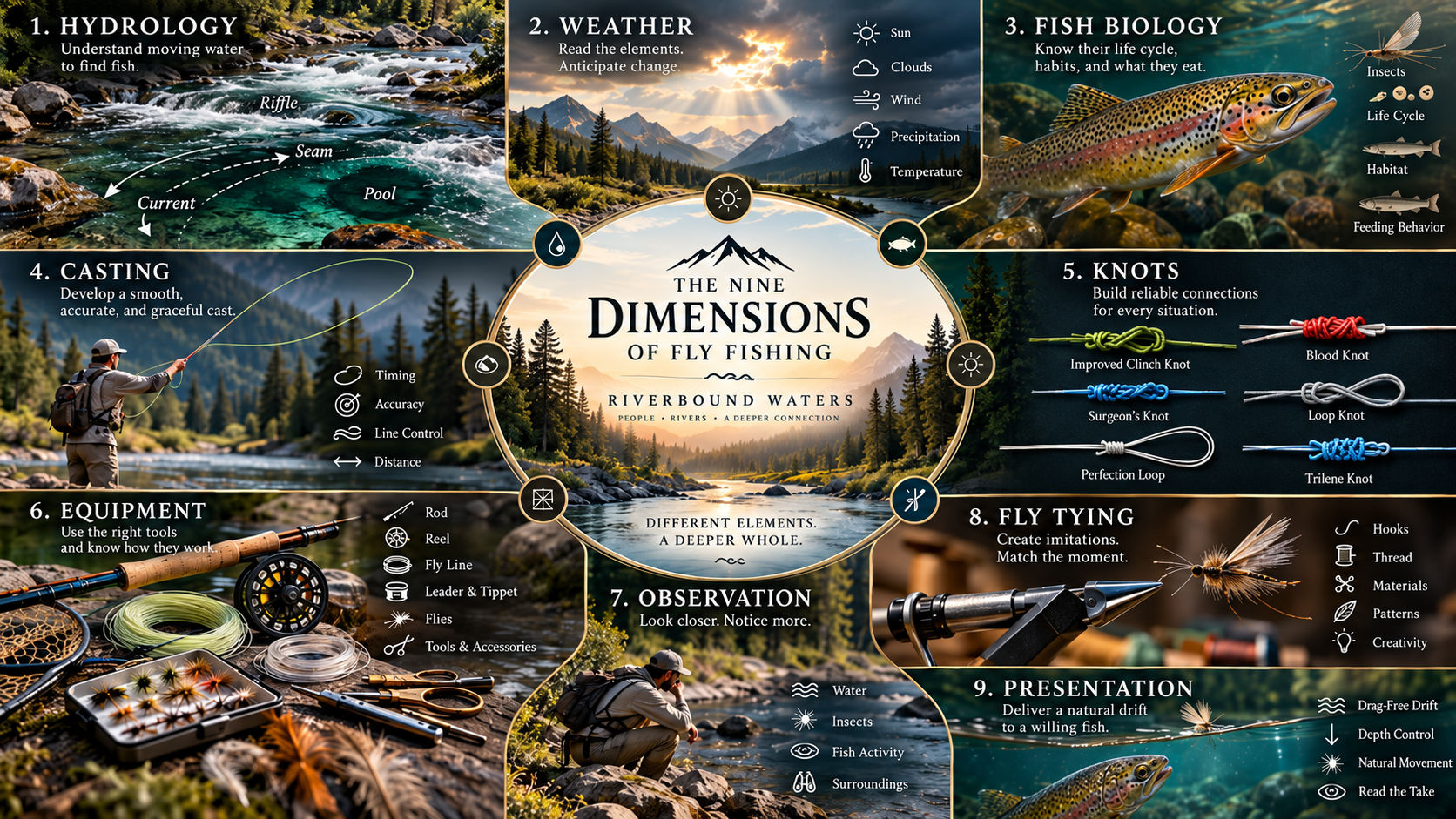
Fly fishing becomes fascinating precisely because so many dimensions come together.
There is entomology.
Hydrology.
Weather.
Fish biology.
Casting.
Knots.
Equipment.
Observation.
Fly tying.
Presentation.
And sometimes something that cannot quite be taught—the instinct that develops after enough hours on the water.
At first, those dimensions can feel overwhelming.
Eventually, they begin to connect.
You notice the swallows flying low over the water and realize insects are emerging.
You turn over a rock and recognize the nymphs attached beneath it.
You see where fast water meets slow water and begin looking for a feeding lane.
You notice the difference between a trout rising to an insect on the surface and one taking an emerger just beneath it.
The river begins providing information.
The angler begins learning how to read it.
That transformation—from simply fishing a river to beginning to understand a river—is one of the experiences Riverbound Waters™ was created to encourage.
Fly Tying Doesn't Have to Feel Multidimensional
At the vise, the philosophy changes slightly.
The natural world may be enormously complex.
Your tying process does not have to be.
Thread.
Tail.
Body.
Thorax.
Wing.
Hackle.
Finish.
One step follows another.
That is why one of the guiding ideas of this project became:
Fly fishing is multidimensional.
Fly tying does not have to feel multidimensional.
When the process is presented clearly, complexity becomes manageable.
That principle reaches far beyond fly tying.
It has been part of my professional life for decades.
From Engineering to the River
Long before Riverbound Waters™, much of my career involved helping people understand complex systems.
I worked in computer-aided testing, computer-aided design, product development, and ultimately Concurrent Engineering—helping companies, universities, and organizations understand how the many activities involved in developing a product influence one another.
The challenge was rarely that people lacked intelligence.
The challenge was that complicated systems were often presented in complicated ways.
My work became centered on organizing those systems so that relationships could be seen and understood.
Years later, I found myself applying many of those same principles to fly fishing.
A river may seem far removed from an engineering organization, but the underlying question is surprisingly similar:
How do all these pieces fit together?
The fish cannot be separated from the water.
The fly cannot be separated from the insect.
The insect cannot be separated from the season.
The presentation cannot be separated from the current.
Everything influences something else.
Riverbound Waters™ grew from the desire to make those relationships easier to see.
The Acorn Skiff
Some of the most important experiences behind this project happened far away from computers, diagrams, and engineering meetings.
They happened in a small wooden boat.
After Carole and I found one another again after forty years apart, we rescued and rebuilt an Acorn Skiff, the beautiful lapstrake rowing design by Iain Oughtred.
The restoration itself became an adventure.
We brought the little wooden boat back to life, and I made a pair of wooden oars for it.
Then we used it.
For years, Carole and I spent hundreds of hours rowing and fishing the alpine lakes around Bend and Sisters, Oregon.
There was something wonderfully simple about those days.
A wooden boat.
Two handmade oars.
Two fly rods.
Clear mountain water.
Trout somewhere beneath us.
And enough time to figure them out.
Those days taught me as much about fishing as any book ever could.
They also reinforced an idea that eventually became part of Riverbound Waters™:
The best fishing experiences are not always about catching the most fish.
Sometimes they are about understanding where you are, slowing down long enough to observe what is happening, and sharing the water with someone important to you.
Although, for the record, Carole usually caught the first fish.
And frequently the biggest.
Learning to Read the Water
A river communicates constantly.
Current speed changes.
Seams form.
Foam collects.
Insects appear.
Birds begin feeding.
Water temperature shifts.
Shadows move across the river.
Trout change position.
The angler who learns to notice those changes gradually becomes less dependent on luck.
That does not mean fishing becomes predictable.
Fortunately, it never does.
Instead, the angler becomes better at asking the right questions.
Why are fish holding there?
Why did the rise stop?
Why are insects present but nothing is feeding on the surface?
Should I change the fly—or change the depth?
Is the problem the pattern?
The presentation?
The drift?
The location?
Those are troubleshooting questions.
And troubleshooting is simply another form of learning.
That is why troubleshooting has such an important place in Riverbound Waters™.
When something does not work, the answer is not always:
Change the fly.
Sometimes the right fly is already tied to the line.
Something else needs to change.
Confidence, Not Rules
Fly fishing has no shortage of rules.
Some are important.
Many are useful.
Some are traditions.
And some are simply preferences repeated often enough to sound like laws.
Riverbound Waters™ is not intended to tell anglers there is only one correct way to fish.
Conditions change.
Waters change.
Fish change.
Anglers change.
What works beautifully one afternoon may fail completely the following morning.
The goal is therefore not rigid instruction.
It is confidence.
Confidence to understand the information in front of you.
Confidence to experiment.
Confidence to change your approach.
Confidence to tie the fly yourself.
Confidence to fish unfamiliar water.
And eventually, confidence to develop your own way of solving the puzzle.
For the Beginning Angler
If you are new to fly fishing, the amount of information surrounding the sport can be intimidating.
Rods have weights.
Lines have tapers.
Leaders have formulas.
Tippet has sizes.
Flies have names that sometimes seem to have little connection with anything living.
Then someone starts discussing mayflies, caddisflies, stoneflies, emergers, duns, spinners, nymphs, and terrestrials.
It can become overwhelming quickly.
You do not need to learn everything at once.
That is one of the most important ideas behind Riverbound Waters™.
Learn one piece.
Then another.
Understand how they connect.
Build confidence gradually.
The objective is not to turn a beginning angler into an entomologist, hydrologist, professional guide, and master fly tier overnight.
The objective is to make the next step understandable.
For the Experienced Angler
Experienced anglers encounter a different challenge.
We accumulate knowledge.
Boxes fill with flies.
Vest pockets fill with tools.
Bookshelves fill with references.
Years of fishing create thousands of small lessons.
But information becomes most useful when it is organized.
The Riverbound Waters™ collections are intended to become references experienced anglers can return to—whether planning a trip, refreshing their understanding of a water, checking a pattern, considering a hatch, or simply looking for another approach to a familiar problem.
The project is designed to grow with the angler rather than be outgrown by the angler.
Respect for the Water
Understanding a fishery also means respecting it.
Rivers and lakes are not unlimited resources.
Conditions change. Regulations change. Access changes. Fish populations change.
Responsible anglers check current regulations, respect private property, handle fish carefully, understand seasonal stresses, and leave the places they visit at least as good as they found them.
Riverbound Waters™ encourages preparation, but no printed reference can replace current information.
Before fishing, anglers should always confirm applicable regulations, closures, access requirements, and current conditions with the responsible agencies.
The privilege of fishing these waters comes with an obligation to help preserve them.
A Reference Designed to Be Used
These books were not created simply to sit on a shelf.
They were created to be used.
Open them at the tying bench.
Use them while planning a fishing trip.
Compare patterns.
Study a river.
Review a rig.
Look at a hatch.
Troubleshoot a difficult day.
Return to them after a season and discover something you overlooked before.
A good reference becomes more valuable as the reader's own experience grows.
That is what I hope happens with Riverbound Waters™.
The Riverbound Waters™ Philosophy
At its heart, Riverbound Waters™ is built around several simple ideas:
Understand the water.
Understand the fish.
Understand what the fish are eating.
Understand the fly.
Understand the presentation.
Then bring those pieces together.
Not perfectly.
Fishing rarely rewards perfection.
But thoughtfully.
Curiously.
Confidently.
Because the greatest satisfaction in fly fishing is not simply catching a trout.
It is reaching the point where you look across a river, notice what is happening, make a decision—and understand why you made it.
That is when the water begins to make sense.
And that is what Riverbound Waters™ is really about.
Know the Water. Understand the Fish. Tie with Confidence. Fish with Purpose.